
No Place After Dark
Sundown Towns, the Blues Road, Black Wealth, and the Boundaries That Remain

Part of the ongoing series on Blues Ecology, the Prison Planet, land, labor, movement, memory, and Black cultural survival.
For the past couple of years, my broadcasts, essays, interviews, courses, and public programs have explored two connected ideas that I call Blues Ecology and the Prison Planet. Blues Ecology is my way of examining the larger environment that produced the Blues and shaped the lives of Blues People. That environment includes the land, labor systems, farms, plantations, towns, highways, railroads, churches, homes, juke joints, businesses, family memories, folk beliefs, and community traditions surrounding the music.
The Prison Planet describes the systems that have attempted to control Black movement, labor, property, resources, and cultural authority. I do not use the term only to describe prisons or incarceration. I use it to study a larger structure of containment that can appear through plantations, segregated communities, policing, housing discrimination, restricted travel, labor exploitation, and institutions that benefit from Black culture while limiting Black ownership. These ideas are connected. Blues Ecology helps us study how Black people lived, created, traveled, remembered, and built community within environments shaped by the Prison Planet.
This essay continues that discussion through the history of sundown towns, the Blues road, Black travel knowledge, Black-owned businesses, and historically Black communities. It asks what happened when Black labor, Black music, and Black money were welcomed into a place, but Black safety, ownership, and belonging were denied. When traveling across the United States, Blues People had to understand and negotiate the racial geography of the country. That reality should be treated as part of the history of the music.
The Unequal Meaning of the Open Road
The American road is often represented as a symbol of freedom, adventure, and independence. Route 66 became one of the most familiar examples of that idea. Popular songs, advertisements, films, and travel writing presented the highway as a place where people could explore the country, search for opportunity, and reinvent themselves.
That idea of freedom was never available to everyone in the same way.
Black travelers needed information that white travelers often did not have to consider. They had to know where they could purchase gasoline, eat, sleep, repair a vehicle, or safely remain after dark. They also needed to know which towns to avoid, which law-enforcement agencies had dangerous reputations, which businesses would serve them, and which homes or communities might help. This history affects how we understand the movement of Blues musicians. Popular accounts often describe the Blues musician as a free traveler carrying music from plantations and farms into towns, cities, clubs, theaters, and recording studios. The movement is real, but the idea of unrestricted freedom is misleading. Traveling through a place did not mean a musician was safe there. A Black musician might be hired to perform for a white audience but still be denied a meal, a room, or access to the front entrance. A band might complete a performance and then have to leave the town immediately. Musicians sometimes depended on private homes, boarding houses, churches, Black-owned businesses, or information shared by other performers.
The road was therefore part of the working conditions of the Blues. It shaped performance schedules, wages, food, lodging, transportation, physical safety, and the ability of musicians to move between communities.
But this was not only true for the traveling musician. It was true for the Black Salesmen, or the family that wanted to experience a vacation by driving cross country, or return back south from the North East or Midwest.
Sundown Towns as Systems of Exclusion
A sundown town was a community that intentionally excluded Black residents or required Black people to leave by nightfall. Some towns displayed signs warning Black people not to remain after dark. In other places, the exclusion was enforced through police stops, violence, threats, restrictive housing covenants, employment practices, discriminatory real estate customs, and locally understood rules. The absence of a sign does not mean a racial boundary did not exist. In many communities, people learned the boundaries through experience, oral history, family warnings, and local reputation.
A Black worker might be allowed to enter a town during the day to clean homes, care for children or older residents, deliver goods, perform agricultural labor, or work in another service occupation. Once the workday ended, that worker could be expected to leave.
A Black musician might be welcomed as entertainment but not accepted as a resident, customer, or property owner.
A Black traveler might be able to pass through town but not stop for food, lodging, or gasoline.
These practices made a distinction between Black usefulness and Black belonging. A town could benefit from Black labor, services, music, or money while denying Black people the ability to live there, own property, participate politically, or build institutions.
This is why sundown towns should not be studied only as expressions of personal prejudice. They also functioned as economic and political systems.
Land, Labor, and Wealth
When racial exclusion is discussed only as a moral failure, we miss part of how the system operated. The moral issue is clear, but exclusion also involved control over resources.
We have to ask who could own land, purchase a home, establish a business, receive a loan, vote in local elections, attend a school, use public facilities, and pass property to the next generation.
When Black families were prevented from buying homes, they lost opportunities to build equity. When Black business owners were excluded from commercial districts, they lost access to customers, credit, and investment. When Black people could work in a town but not live there, their labor supported the local economy without giving them political authority or a long-term claim on the community.
Sundown towns helped separate Black labor from Black ownership.
This relationship also appears throughout the history of Black music. Black musicians have often been invited to perform in places where Black people had limited access to property, management, or decision-making power. Black music could be celebrated while Black people remained excluded from ownership of venues, festivals, record companies, archives, museums, and other institutions built around the music.
The issue was not simply whether Black culture was appreciated. The more important questions concern who controlled the space, who received the financial benefit, and who had the authority to define the tradition.
Those questions remain central to my work on the Prison Planet.
The Prison Planet as a System of Containment
The Prison Planet is a framework for examining systems that control movement, labor, time, space, and resources.
The plantation was one form of this system. It controlled where people lived, how they worked, when they moved, and who benefited from their labor. After slavery, other systems—including sharecropping, convict leasing, debt, segregation, discriminatory lending, policing, and housing restrictions—continued to regulate Black life in different ways.
These systems were not identical, and they should not be treated as if nothing changed over time. However, we can still identify continuities in their basic functions.
Who controls the land?
Who controls movement?
Who controls labor?
Who controls access to capital?
Who controls the institutions?
Who controls the historical narrative?
Sundown towns were one expression of this larger structure. They turned town limits and municipal boundaries into racial borders. They regulated where Black people could travel, work, live, own property, and participate in public life.
Studying sundown towns through the Prison Planet allows us to place them within a broader history of controlled movement and restricted ownership.
Blues Ecology and the Geography of the Road
Blues Ecology studies the environments in which Black cultural expression developed. The environment includes the natural landscape, but it also includes roads, railroads, labor systems, neighborhoods, institutions, businesses, churches, entertainment spaces, and social relationships.
The Blues road is part of this ecology.
Roads connected musicians and communities. They allowed performers to carry songs, stories, performance practices, and information from one location to another. At the same time, those roads exposed Black travelers to policing, exclusion, violence, and economic risk. The movement of the Blues depended on more than the musician. It also depended on drivers, family members, club owners, boarding-house operators, cooks, mechanics, church members, business owners, and community residents who shared information. The movement of the people, who disseminated the culture cross country!
This wider network is often left out of Blues history. Music does not move by itself. People, property, institutions, and community relationships make movement possible. The frequent references to trains, roads, migration, departure, work, police encounters, separation, and homecoming in Blues music are connected to material experiences. These subjects were part of how Black people understood the landscape and communicated information about movement, danger, opportunity, and survival.
Also, remember in many August Wilson plays, as well as in our own family memory, the traveling musician would return home with stories from abroad. Young family members want to experience and explore, as older family members listened with concern, yet highly anticipated what their traveling loved one will share.
The Green Book and Black Travel Knowledge
Black communities developed systems of travel knowledge long before that information appeared in print.
Families warned one another about dangerous towns and roads. Musicians shared information about venues, boarding houses, service stations, and police departments. Railroad porters, business owners, churches, and experienced travelers helped people locate food, lodging, fuel, and assistance.
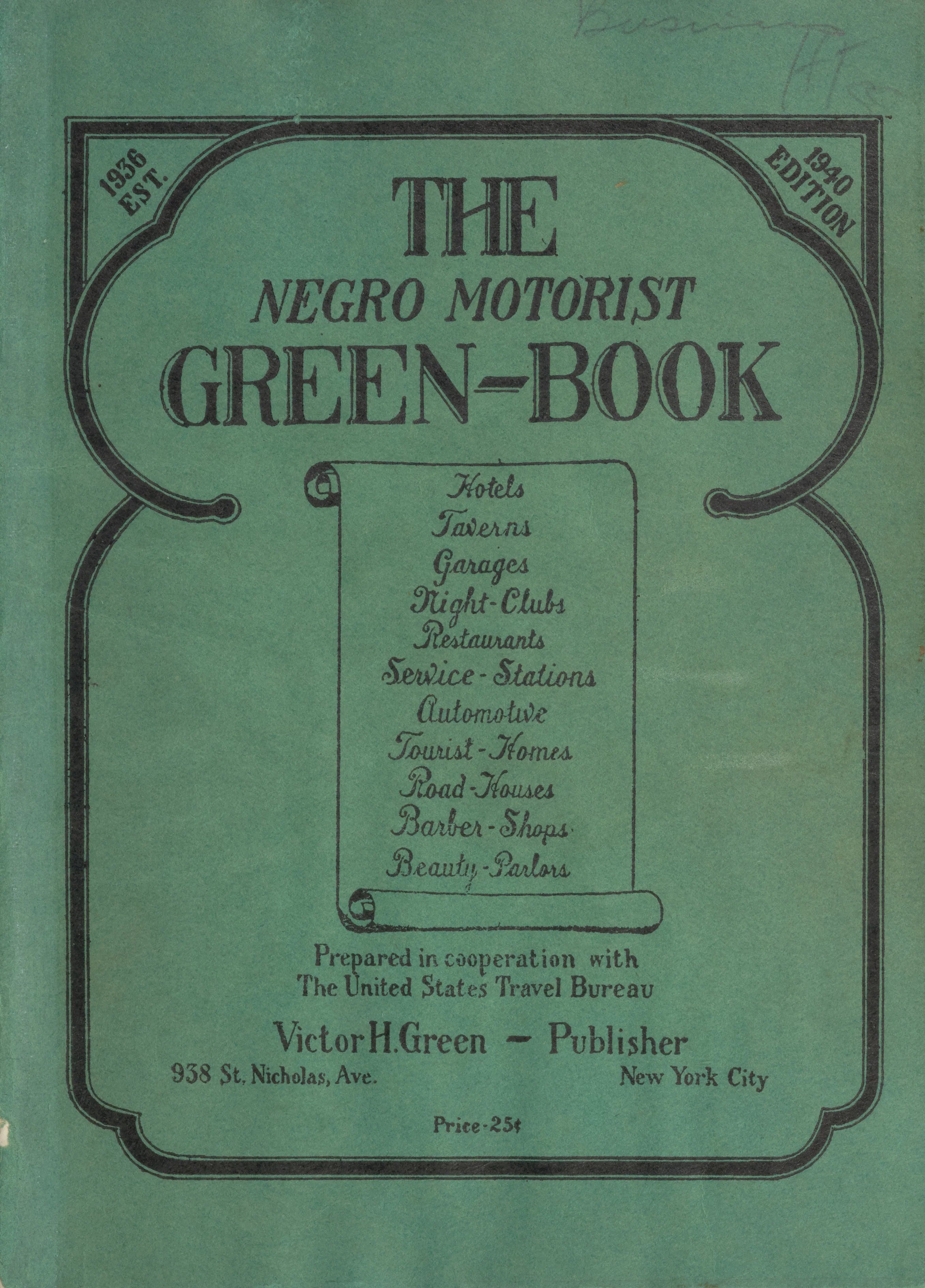
In 1936, Harlem postal worker Victor Hugo Green began publishing The Negro Motorist Green Book. The guide identified hotels, restaurants, tourist homes, service stations, and other businesses where Black travelers could expect to receive service. The Green Book did not invent Black travel knowledge. It organized and printed information that was already circulating within Black communities. It made part of that knowledge portable. The guide was also a record of Black economic activity. Each listing represented a business, property owner, worker, family, or institution participating in a wider network of Black travel and commerce.
A hotel or boarding house offered more than a bed. A service station offered more than gasoline. These sites helped make movement possible in a country where ordinary travel could become dangerous. Money spent at these establishments could support Black workers, families, churches, schools, and community institutions. The Green Book therefore documented both segregation and the Black economic networks developed in response to it.
We should not treat the guide as evidence that segregation was manageable. The need for such a publication demonstrated that Black people could not assume equal access to public accommodations or safe travel within their own country. At the same time, the Green Book reflected Black publishing, entrepreneurship, communication, and mutual support.
It is also important to recognize that the Green Book did not include every location used by Black travelers. Working-class travelers and musicians often relied on places known through word of mouth. Private homes, informal boarding houses, farms, churches, clubs, and local businesses formed another network that may not appear in the official record.
This distinction matters because the printed archive is never the complete archive.
I approach subjects such as sundown towns and Black travel through what I call the Three Trails Method: the Paper Trail, the People’s Trail, and the Sound Trail.
The Paper Trail includes ordinances, property deeds, census records, restrictive covenants, arrest records, newspapers, maps, business directories, and travel guides. These sources help us understand how exclusion was organized through policy, property, policing, and economic practice.
The People’s Trail includes family warnings, musician stories, community reputations, safe houses, oral histories, and memories of where Black people could stop, eat, sleep, perform, purchase gasoline, or safely remain. These accounts help explain how official policies affected daily life.
The Sound Trail includes Blues songs, interviews, field recordings, broadcasts, performance histories, and memories associated with trains, roads, labor, policing, migration, departure, and return.
No single trail provides the complete history.
A census can show that few Black residents lived in a town without explaining why. An ordinance might be repealed while the local custom continues. A newspaper may describe an official policy without documenting how Black families experienced it. A community memory may identify a boundary that the written archive ignored.
Interviews are particularly important because they allow people to explain how they understood a place, what warnings they received, how they traveled, and what they experienced. The interviews I have conducted with Blues musicians, culture bearers, community scholars, and residents help connect official records to the experiences of the people. These conversations are not secondary decoration. They are part of the archive.
As this series continues, I will continue bringing those interviews into the discussion as I have done in recent essays. They help us understand the emotional, economic, and cultural realities behind the maps, ordinances, and travel guides.
Oklahoma and Competing Geographies
Oklahoma is an important location for this discussion because its history includes both racial exclusion and Black community building.
One geography restricted where Black people could travel, settle, own property, or remain. Another geography was created through Black towns, farms, businesses, churches, schools, newspapers, clubs, and local governments. Oklahoma’s Black history is also connected to Indian Territory, forced removal, Native nations, enslavement within the Five Tribes, emancipation, Freedmen communities, land allotment, and later state segregation. These histories are connected and require careful dissemination.
The state became home to a significant number of historically Black towns and settlements. Communities such as Boley, Langston, Rentiesville, Taft, Clearview, Redbird, and Tullahassee represented Black political and economic organization. These towns should not be understood only as places where Black people settled because white communities rejected them. They also represented efforts to create land ownership, municipal government, businesses, schools, churches, newspapers, farms, professional services, and family property.
In these communities, belonging had a material meaning. It meant the ability to own, govern, build institutions, and participate in public life.
The towns experienced serious challenges, including changes in agriculture, the Great Depression, transportation shifts, discriminatory lending, disinvestment, limited access to capital, and out-migration. Their later struggles should not erase what they accomplished.
The history of these towns shows that Black history is not only about the places from which Black people were excluded. It is also about the places Black communities created and maintained.
The Threatt Filling Station
The Threatt Filling Station near Luther, Oklahoma, provides an example of how Black ownership supported safe travel.
Located on family land along Route 66, the station served local residents and travelers navigating segregation. It offered fuel, food, rest, information, and a place where Black motorists could expect to be treated with dignity.
The station was both a business and a form of community infrastructure.
Money spent there supported a Black family, while the location helped other Black families travel more safely. The site demonstrates the relationship between land ownership, economic independence, and mobility. The station also helps us understand why preservation matters. Preserving a location such as the Threatt Filling Station means preserving evidence that Black businesses played a practical role in protecting travelers and maintaining community networks.
This is part of Blues Ecology because it connects land, travel, business, community knowledge, and cultural movement.
The Greenwood District in Tulsa represented another form of Black institution building. The community included homes, businesses, churches, professional offices, newspapers, entertainment spaces, and other institutions.
Greenwood demonstrated what could happen when Black labor, money, professional knowledge, and community relationships circulated within a Black-controlled economy. The destruction of Greenwood should not be understood only as an act of racial hatred. It was also an attack on Black property, business ownership, economic independence, and political authority.
When homes and businesses were destroyed, families lost property, employment, commercial relationships, and resources that might have been passed to later generations.
Racial violence and economic violence operated together.
Greenwood also challenges the claim that Black communities lacked the ability to build successful institutions. Black communities repeatedly demonstrated that ability. The larger problem was that Black achievement often encountered organized violence, legal obstruction, discriminatory lending, and disinvestment.
The central question is not whether Black people knew how to build. The historical record shows that they did. The question is why Black ownership and authority were so often treated as threats.
Rentiesville and Cultural Stewardship
Rentiesville, Oklahoma, offers another example of Black place-making and cultural stewardship.
Through the work of D.C. Minner and Selby Minner, the town became associated with the Oklahoma Blues Hall of Fame and the Dusk ’Til Dawn Blues Festival. Their work connected Blues performance with community memory, education, local history, and cultural preservation.
This example is especially important in a discussion of sundown towns.
In a sundown town, darkness represented a deadline by which Black people were expected to leave. In Rentiesville, the evening became a time for people to gather around Black music, history, and community. The Blues tradition there should not be treated simply as entertainment. It became part of the town’s cultural and economic life. It brought together land, music, memory, community participation, and stewardship.
Black Agency and the Full Historical Record
A serious discussion of racial exclusion must also recognize Black agency.
Black communities did not simply experience these systems. They studied the conditions around them, shared information, purchased land, created businesses, opened homes to travelers, formed towns, established churches and schools, organized musical networks, and developed strategies for survival.
Recognizing agency does not lessen the seriousness of the oppression. It gives us a more complete account of the people. Black people were not only workers and travelers. They were business owners, landowners, publishers, musicians, organizers, teachers, historians, and community stewards.
This is one reason I describe the Blues as a Black cultural archive. The music preserves experiences of labor, movement, migration, exploitation, danger, family separation, resistance, and survival.
The history of the Blues cannot be separated from the homes, businesses, towns, travel networks, and community relationships that supported the people who created it.
The Boundaries That Remain
The old signs associated with sundown towns may no longer be visible, but the larger questions remain relevant.
Where is Black labor still welcomed while Black leadership is resisted?
Where is Black culture celebrated while Black ownership is limited?
Where are musicians invited to perform but excluded from decisions about the festivals, museums, archives, and institutions built around their traditions?
Where does Black money enter a community without circulating through Black-owned businesses?
Who owns the venue?
Who controls the archive?
Who receives the grant?
Who manages the museum?
Who operates the festival?
Who writes the historical marker?
Who has the authority to define the tradition?
These questions connect the history of sundown towns to current debates about cultural preservation and economic justice.
We cannot preserve the Blues responsibly without considering the material conditions of Blues People. We cannot discuss the movement of the music without studying the roads, businesses, homes, and community networks that made that movement possible.
The history of sundown towns shows how racial systems restricted Black movement, ownership, and belonging. The Green Book, Black-owned travel businesses, Oklahoma’s historically Black towns, Greenwood, and Rentiesville demonstrate how Black communities responded through institution building, economic organization, information sharing, and cultural stewardship.
This essay is part of a larger body of work examining Blues Ecology and the Prison Planet. Future installments will draw more directly from interviews, fieldwork, archival records, family histories, and the Three Trails Method to examine how Black people traveled, built communities, preserved knowledge, and maintained cultural authority.
For paid subscribers, the continuing series will include extended interview material, research notes, primary-source discussions, teaching resources, worksheets, audio selections, and closer examinations of the places and people introduced here.
The goal is not simply to retell familiar history. It is to develop a fuller understanding of the environments that shaped the Blues and the people who carried it.